what events led to dantes exile from his hometown?
/https://tf-cmsv2-smithsonianmag-media.s3.amazonaws.com/filer/25/b3/25b38dd7-e0e2-46c8-a60b-01e4cb518741/dante_main.jpg)
September xiv, 2021, marks the 700th anniversary of poet Dante Alighieri'due south decease. A year-long celebration, Viva Dante, began in Italy in September 2020, with events from public readings to concerts to church services in his honour—and notwithstanding many more in the works. In addition, institutions around the world are offering both virtual and in-person exhibits, tours and discussions that people can attend to learn more than about Dante's life.
Dante was born in Florence in 1265. The Alighieri family came from a branch of the house of Elisei, founded by the married woman of Cacciaguida, a warrior who died in the Second Crusade. Dante'southward parents (Alighiero di Bellincione Alighieri and Bella di Abati) were pocket-size nobility, and then he grew up among the elite. Every bit a teenager, he held an apprenticeship with poet and writer Brunetto Latini. After aligning with the losing political political party in 1301, he was exiled from his hometown. He traveled for a few years through Bologna, Verona, Venice, Rome, Lucca and Siena before settling downwardly in Ravenna, in northern Italian republic, for the latter function of his life. One of Dante'due south descendants, astrophysicist Sperello di Serego Alighieri, is working to have the poet posthumously pardoned, arguing that his sentence was motivated purely by tainted political motivations at the time.
Dante authored the Divine Comedy, an epic poem that contains three parts (Inferno, Purgatorio and Paradiso) and traces Dante's journey from death to sky. He was the first Italian writer to eschew Latin and really work in his mother tongue. It was during his travels while he was exiled and his subsequent life in Ravenna that Dante wrote the verse form; it's estimated he started information technology in 1308, when he was 43, and finished it in 1321, the year he died of malaria at age 56.
"For hundreds of years, Dante has been historic as the father of Italian poetry," says University of Bologna professor and Dante expert Claudia Sebastiana Nobili. "Every bit such, he is also the begetter of the Italian language. In his poem, he used many words for the kickoff time, translating them from Latin or borrowing them from other European languages, such as French, Provençal, Spanish and Standard arabic, thus creating a very rich literary language."
According to Guy Raffa, an acquaintance professor of Italian studies at the University of Texas at Austin and the author of Dante's Bones: How a Poet Invented Italy, writing in Italian opened Dante'southward work up to even more than people. "Only the very elite could sympathise [Latin]," Raffa says. "So he chooses to go more accessible."
To make the life and work of the poet of the late Middle Ages and early Renaissance accessible to people today, Viva Dante has offered up daily readings from the Divine Comedy outside Dante'south tomb in Ravenna, an event that is expected to continue in perpetuity; readings in every city he lived in from strange writers who discuss how he impacted their lives and work; a special exhibit called "The Eyes and the Heed" at Ravenna's Classense Library near Dante'south time in exile; a theatrical guided tour of Ravenna chosen Silent Play for Dante; and an exhibit chosen "A Pop Epic" at the Ravenna Museum of Art about Dante's impact on mod popular civilization. The Uffizi Gallery in Florence is also hosting a free online exhibition of Dante'due south drawings from The Divine One-act. And on May 19, the Smithsonian Associates will host "Dante Without Footnotes," a virtual give-and-take about his epic.
For those who can't make information technology to Italia to celebrate Viva Dante in person, honor the poet'south memory by learning nigh these half dozen spots where Dante lived, worked and died.
Museo Casa di Dante, Florence
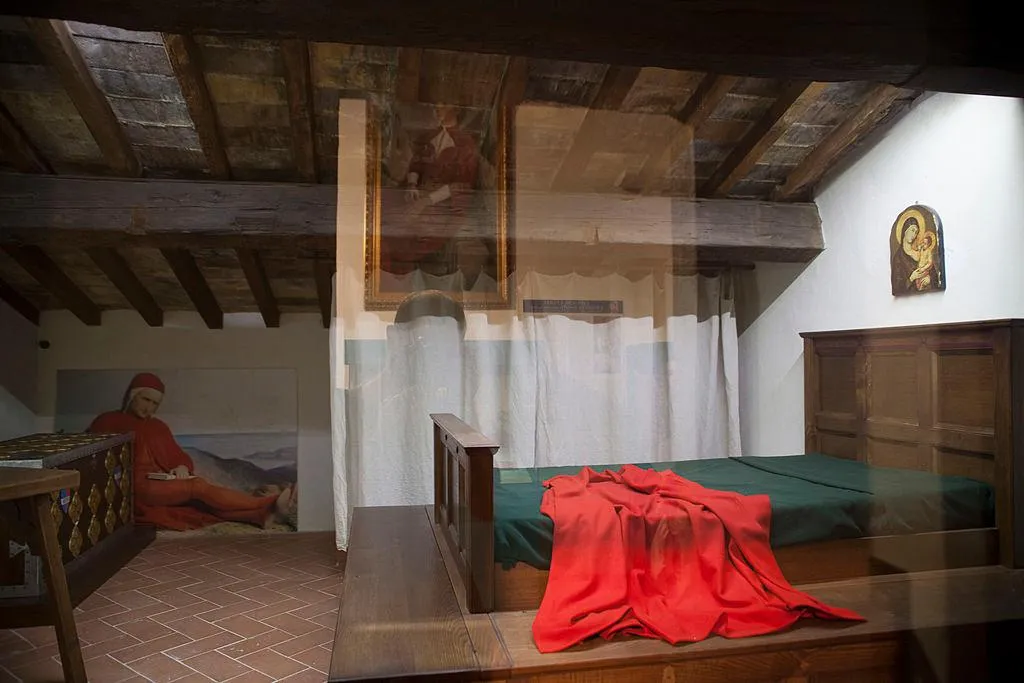
Dante was born in this firm in 1265. His family was minor nobility in Florence, descended from a participant in the Second Cause. Dante's mother died when he was only almost 10; his begetter remarried and had two more than children, a male child and a girl. Dante left Florence in 1301 later on years of schooling and an bundled marriage. He was part of a delegation of the White Guelphs political political party that visited Rome to see the Pope and try to terminate him from annexing Tuscan land. While he was gone, the opposing political party, the Blackness Guelphs, took power in Florence. They believed the Pope should govern church and state, while the White Guelphs did not. The new political party condemned Dante, accusing him of corruption. He was ordered to pay a fine and was exiled for two years. But since he was in Rome, he could non pay his fine—and the judgement was changed to a death judgement if he came back to Florence. Dante never returned.
The firm today doesn't look quite the same as it did when Dante and his family lived there. Dante's brother, Francesco, sold a portion of the house to a different family about 10 years after Dante's death. Futurity owners remodeled the firm significantly, and it eventually barbarous into busted. Just it was always known as "Dante's Business firm" by locals. In 1865, the metropolis of Florence decided to purchase the business firm. Information technology had been 600 years at that point since Dante'southward birth. Florence officials wanted to verify the home was actually where Dante was born, and they were able to do that because documents exist of a lawsuit brought against the Alighieri family claiming that roots from a fig tree on their property were destroying a church wall. In 1911, the city was finally able to reconstruct and restore the house.
The Museo Casa di Dante opened in the house in 1965. It has three floors. The start covers life in 13th-century Florence, plus Dante'southward youth and his eventual exile. On the second floor, visitors can explore Dante's literary training, his connexion to the origins of the Italian language, a replica of the poet's sleeping room, and a bear witness most the Divine Comedy. The 3rd floor contains a virtual reality exhibit of Florence as Dante experienced information technology and a wait at the Florence of today. You can have a virtual tour on the museum'south website.
Battistero di San Giovanni, Florence
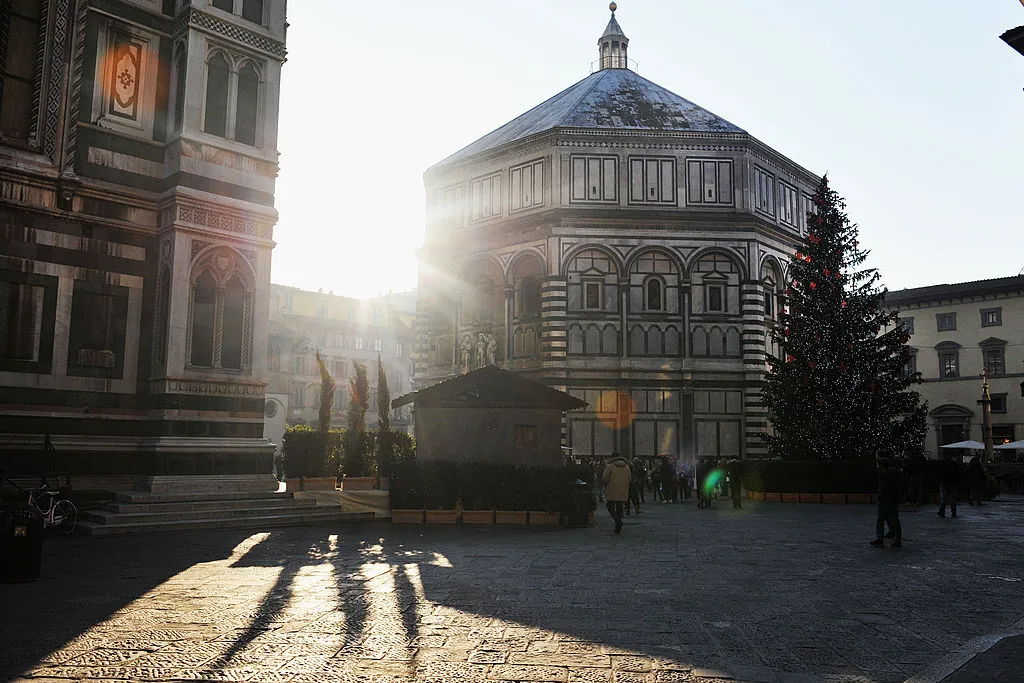
On March 26, 1266, Dante was baptized in this building—simply like all Christians born in Florence were until the end of the 1800s. The baptistery was far older than Dante when he was there, though. Built on ruins of a 4th-century Roman temple, the edifice became the city's cathedral in 1059 and eventually the official baptistery in 1128.
Dante memorialized the green and white octagonal Romanesque building in the Inferno, writing in Canto XIX, 16-18:
No smaller or no larger they seemed to me
Than are those booths for the baptismal fonts
Congenital in my beautiful San Giovanni
He mentions it again in Canto XIX, 19-21, while speaking of a fourth dimension he saw a child drowning in a font and broke it to save that kid's life:
And one of those, non many years ago,
I broke up to save someone drowning in information technology:
And let my give-and-take here disabuse men'south minds
"[At the baptistery], he was able to encounter the wonderful mosaic of the Last Judgment, which probably inspired his ain Inferno," Sebastiana Nobili says.
The baptistery is currently closed due to Covid-19 regulations, simply typically you tin buy a combination ticket that allows you to bout it and other nearby sites including the Duomo and the Florence Cathedral. A small selection of virtual tours are available online.
Chiesa di Santa Margherita dei Cerchi, Florence
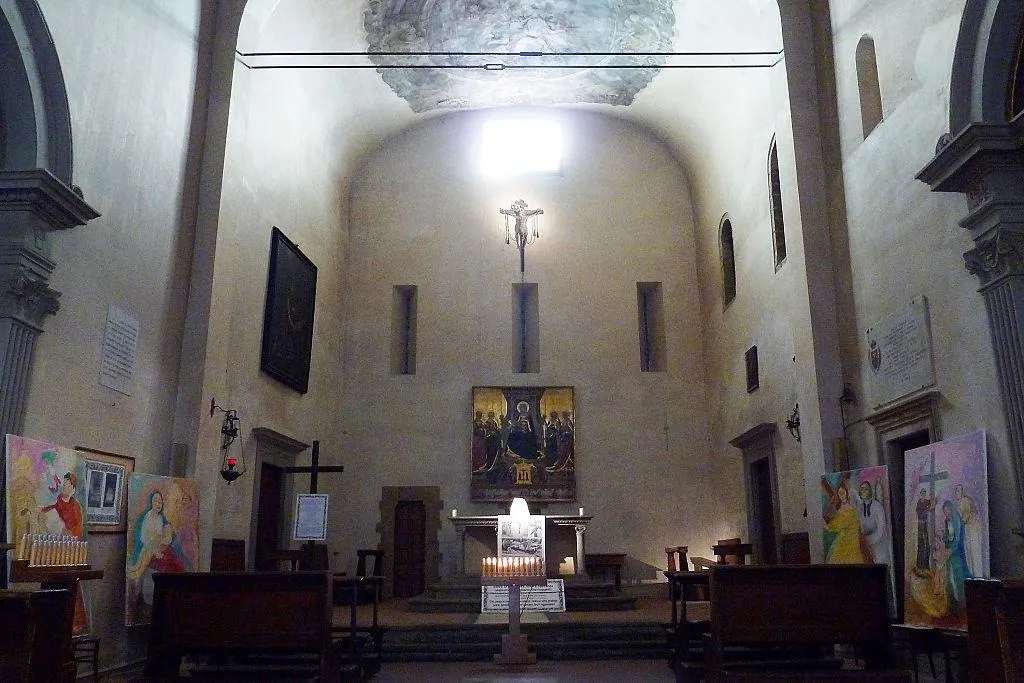
Also known equally the Church building of Dante, the Chiesa di Santa Margherita dei Cerchi was the poet'due south family church building. They attended mass here, along with other prominent families in Florence—including the Portinari and the Donati families. Dante met Beatrice Portinari in this church and allegedly fell in love with her when he was only 9 years onetime. She would go on to exist his muse and inspiration; he dedicated the Divine Comedy to Beatrice. Sadly for Dante and Beatrice, though, they were both married off to other people when they came of age. Beatrice married into the Bardi family, and Dante had an bundled wedlock to Gemma Donati. Their wedding took place in this church effectually 1285. Today, information technology'southward open to the public with free tours.
Scala Family Palace, Verona
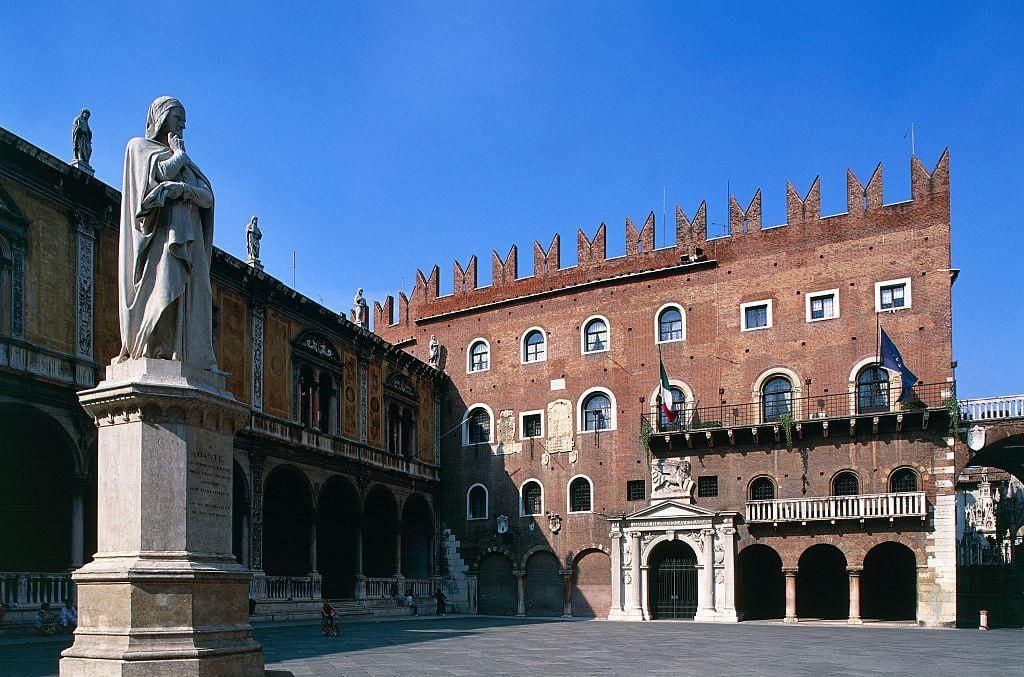
When Dante was first exiled from Florence, he headed to Verona. He found refuge at the Della Scala family unit home; the Della Scalas ruled Verona in the 13th and 14th centuries. Dante spent 7 years here, outset taken in and protected by Bartolomeo della Scala from 1303 to 1304, whom the poet named "gran Lombardo" in Paradiso (XVII, 70), the third and terminal office of the Divine Comedy. He returned in 1312, staying until 1318, nether the watchful eye of Bartolomeo's brother Cangrande I. Dante dedicated Paradiso to Cangrande and wrote the bulk of information technology during his stay in Verona. The square merely outside the palace is a popular destination for locals and tourists alike and has a sculpture of the poet dating back to 1865.
Basilica of San Francesco, Ravenna
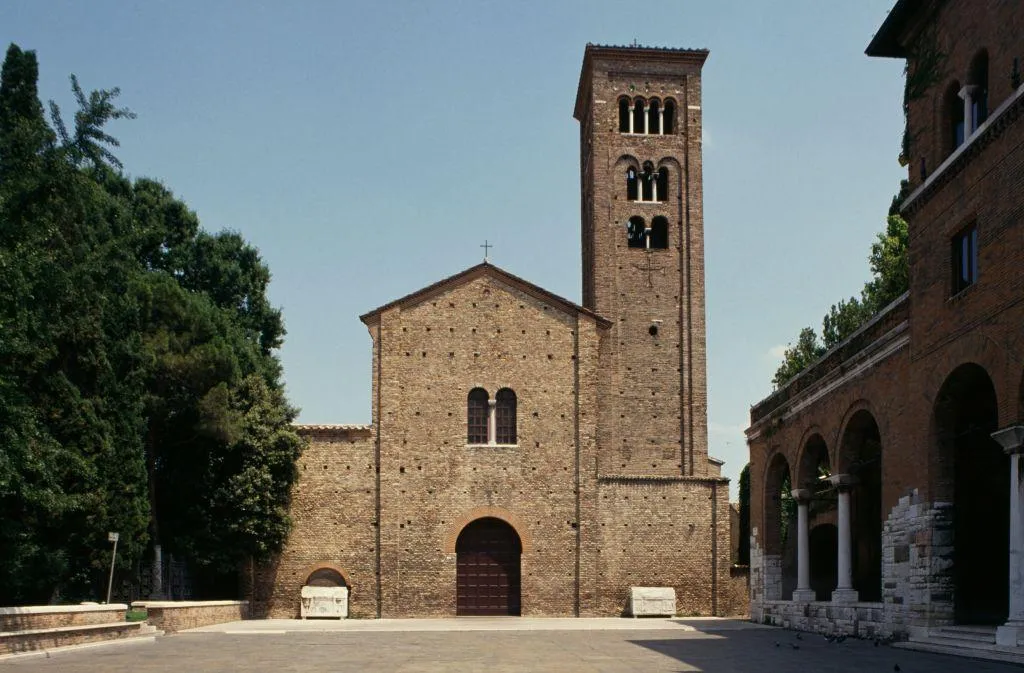
Dante arrived in Ravenna effectually 1318, later on being invited past the ruler at the time. Once there, he made the Basilica of San Francesco his dwelling house church, though at the time it was dedicated to Saint Peter. He prayed there, he went to mass there, and when he died only three years after coming to the metropolis, his funeral was held in that location. All the Ravenna aristocracy attended, and afterwards, he was placed into a marble sarcophagus and left outside the cloisters for almost 160 years.
The earliest church on this site dates back to 460. Information technology was replaced around 875 with a larger church, which was and so renovated in the 17th and 18th centuries to exist more baroque in mode. Just in 1921, in timing with the 600th anniversary of Dante's death, the church building was renovated once again—this fourth dimension restored to how it would accept looked during Dante's time. For that reason, if he were to see it now, information technology would exist familiar: a elementary arched archway, a plain brick façade and a double-arched window above the door. Perchance the but difference would be the crypt in the basement. The church sank and had to be elevated several times; the crypt is now below body of water level and always flooded. In information technology, goldfish lazily swim over some of the original mosaic tiled floors that tin notwithstanding be seen through the h2o—provided visitors put one euro into the machine at the entrance to the crypt. The fee turns on the lights to meet both the fish and the tiles. Sometimes ducks come to bladder on the h2o as well.
Dante's Tomb, Ravenna
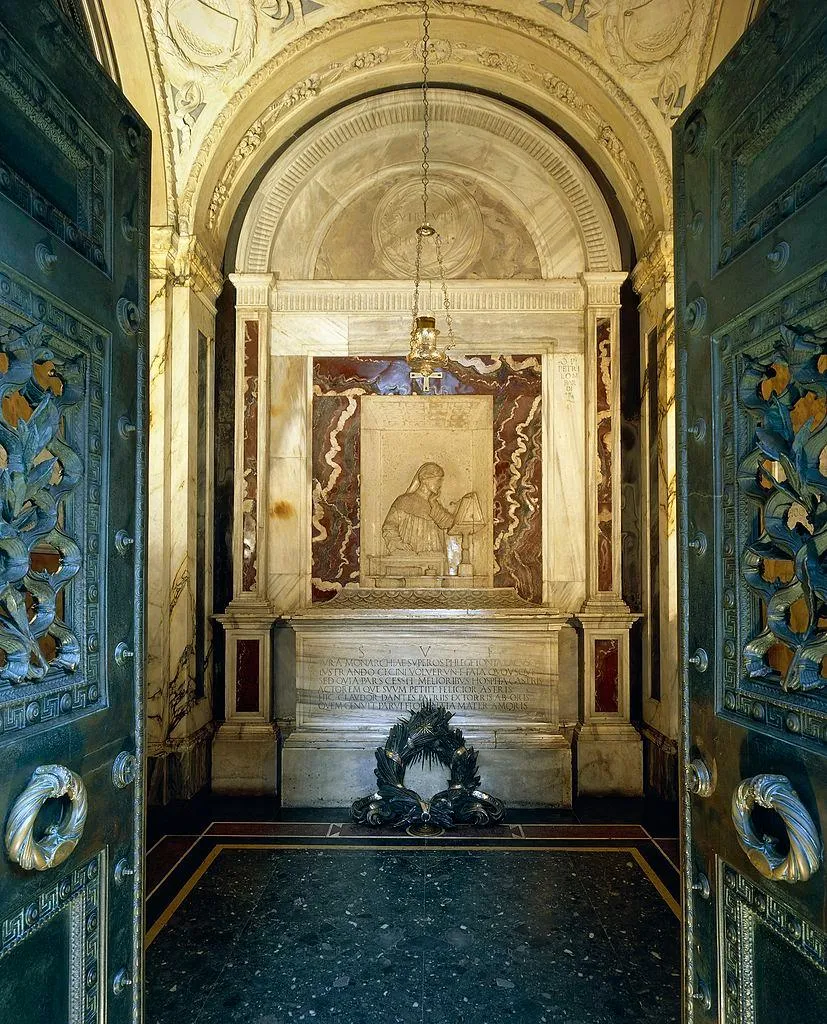
Next to the Basilica of San Francesco, a minor mausoleum holds Dante's bones. The tomb was built in 1780, long after Dante's death in 1321, cheers to a fight over the expressionless poet's remains. Leadership in Florence decided in the 1500s that they wanted Dante's bones back in his hometown. Ravenna told Florence to come recollect them, so the city sent a delegation to Ravenna to become them. Ravenna wasn't having it, though, and the Franciscan monks protecting Dante'southward trunk hid his remains. When the Florentine delegation opened his sarcophagus and found nothing inside, the monks feigned innocence. In 1781, during the structure of the current tomb, the friars returned the bones to their original urn, put it in a box, and hid it. This fourth dimension, they were hiding the basic from Napoleon's troops.
"His bones were accidentally found by a stone stonemason [in 1865] as they were renovating a chapel that'south nearly 35 feet away or and so from his original tomb," says Raffa. "They just fell out of a wall. And so they had to open up his original tomb, manifestly. The final thing you want to practise is find a 2d body, right? In that location's a whole history of saints and relics where that actually happened, but sure enough, Dante'southward tomb was empty."
Dante'due south newly discovered bones were officially moved into the 1781 tomb. E'er hopeful Florence, though, erected a cenotaph in 1829 for Dante in the Basilica di Santa Croce, which remains empty to this mean solar day.
Today, the tomb in Ravenna bears two inscriptions. One on the outside marks it every bit "Dante Poetae Sepulcrum," and one on the inside, on the sarcophagus itself, attempts to punish the Florentines for exiling him in the get-go place. It translates to, "Here in this corner lies Dante, exiled from his native land, born to Florence, an unloving mother." Florence pays a picayune bit every year for this tomb, though; the oil lamp hanging from the ceiling inside is fueled by olive oil sent from Florence each yr on the anniversary of Dante's expiry.
A pocket-sized mound of globe outside the mausoleum marks the spot where Dante's urn was reburied during World War II, so that it didn't go destroyed from any bombings.
"They were afraid he was going to get pulverized in the tomb," Raffa says. "They buried him about 20 feet hole-and-corner under a concrete bulwark and so that he wouldn't get diddled to $.25. And they also did information technology because they were afraid the Nazis were going to steal them. That's the concluding time his basic are actually misplaced or displaced and moved."
Dante's tomb and mausoleum are currently open to visitors for free.
Source: https://www.smithsonianmag.com/travel/follow-dantes-footsteps-through-italy-180977029/
0 Response to "what events led to dantes exile from his hometown?"
Postar um comentário